
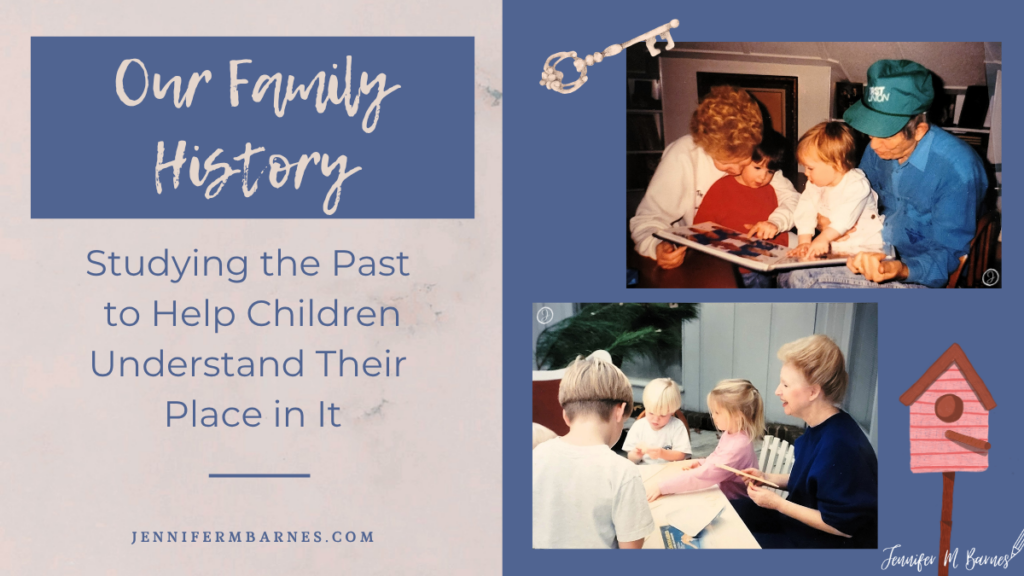
I’ve been thinking about the past lately.
Maybe it’s because I’m getting older. Or because I dove into Eva Marie Everson’s Miss Beth Bettencourt, about a young lady in a 1960’s Georgia town. Or perhaps it’s because we’ve just experienced the birth of a precious grandchild and excitedly await another in just 3 months!
All those vibes have definitely sent me down Memory Lane. They compel me to think of our family history and how I just have to share it with little people. Parents and grandparents have often asked me about how I studied the past alongside kindergartners and first graders.
Those Unforgettable Grandparent Expert Projects
The first thing I usually think of when I remember my students interacting with their grandparents are Grandparent Expert Projects. Some of my most favorite first grade memories revolve around our family history presentations and the sweet relationships they portray. (Take a glimpse back at these amazing creations.)
But I want to highlight sweet memory-builders we can share right now to encourage young children and older loved ones everywhere. Whether you’re an elementary school teacher, a homeschooling family, or simply a parent or grandparent wanting to capitalize on rich experiences, read on to discover unforgettable experiences you can start today!
Priceless Experiences in Studying Our Family History and Those of Our Classmates and Friends
Build Timelines that Frame Our Nation’s History and Our Family History
A favorite colleague filled an everchanging timeline in her K/1 classroom with significant discoveries her students had found. Although I had taught for many years, I honestly never considered the impact of such an endeavor. But when we combined our classes for an astronomy study for several weeks, I realized what a game-changer it became for my students, too. When they saw important space discoveries aligned, they developed a deeper understanding of history and astronomy.
Even though some of them couldn’t read the years!
They simply recognized that events cascaded into other events, leading to new discoveries. This skill of identifying the before/afters transformed their thinking. “You mean, Galileo’s work happened hundreds of years earlier?”
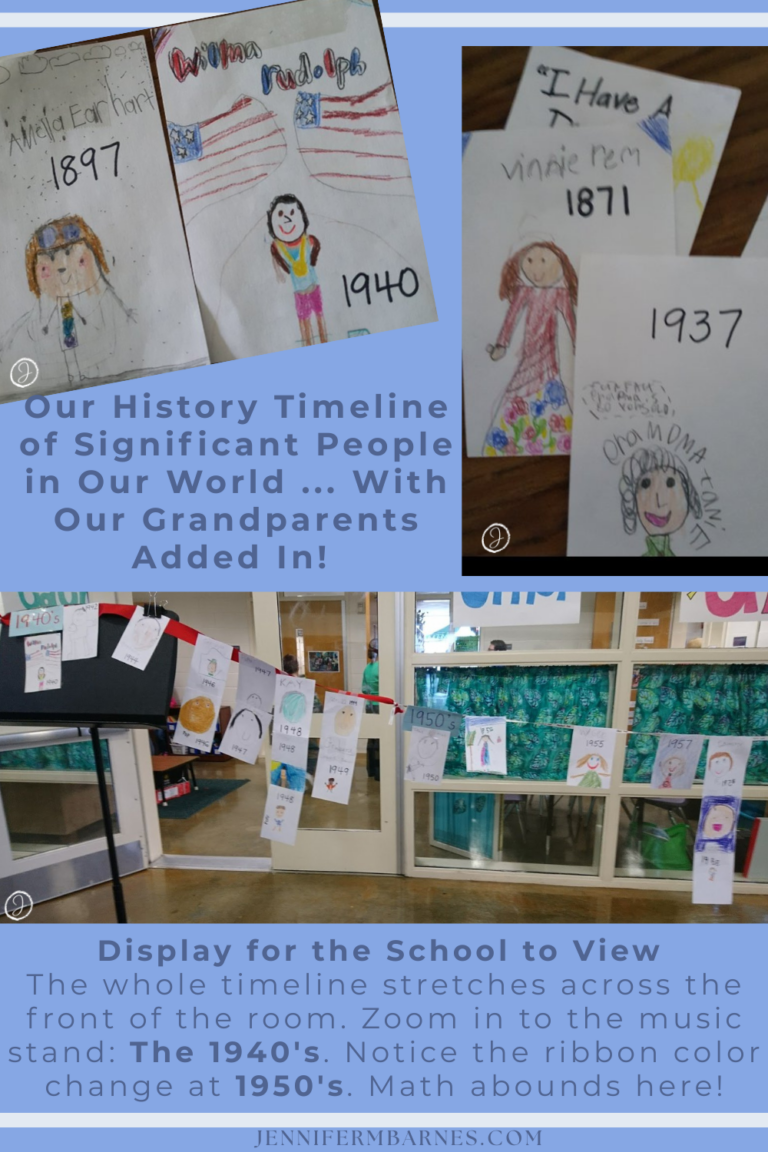
When we returned to our classroom, these understandings pushed us to collect significant historical people and start a timeline of our own. We gathered Olympians (Wilma Rudolph), presidents (Teddy Roosevelt and John F. Kennedy), and religious leaders (Billy Graham and Martin Luther King, Jr.) When we combined them with cards of their own grandparents, children could see who lived and impacted the world at the same time their grandparents were living. (Teacher Note – To add an element of math: when we hung the cards, we changed ribbon colors every 10 years. It became easier to figure out how many decades separated people and events.)
So, you might consider keeping a running record of interesting people you come across—from people in your community, museum visits, books, or relatives.
On 5×7″ index cards:
- Sketch the person
- Write their name and perhaps their significance in your little ones’ lives
- Document their year of birth
- Add in those sports stars, favorite dancers, authors, inventors—whoever inspires your children!
- Don’t forget to include your own family members.
You’ll definitely see your family history differently through your children’s eyes!
Visit insightful places
Taking field trips together can be the perfect catalyst to find those people of interest. You might head to the local historical museum, the community farmer’s market, or other tourist attractions.
Yes, even tourist attractions are fun places to visit and double as interesting places to learn (Take Dollywood’s old schoolhouse and eagle sanctuary, for example).
While visiting places, you will create beautiful memories to savor for years to come. (Tip: Take lots of photos to build up your family history. And don’t neglect to take a few with you in them! You know you’ll love them. But think how those little ones could treasure them for decades to come.)
Participate In a Project Together
After visiting places of interest, little kids often say, “We could do this, too. Couldn’t we?” Here’s a few ideas:
- Create a family garden. My kindergarten families helped create an amazing storybook garden in our back yard at school. Then later with my grandson, we designed a fairy garden first. Then it transformed into a dinosaur garden filled with blue flowers. Who knows what it will be next?
- Build a birdhouse or birdfeeder. Keep them loaded with bird seed. Grab your binoculars and an identification guide—and just start watching. Maintain a running list of the types of birds you discover in your yard. Someday you might join the Great Backyard Bird Count hosted by the Cornell Lab of Ornithology and National Audubon Society each year. (You can observe and count for as little as 15 minutes—or as much as you want—from February 12-15, 2027.)
- Catch some critters. While gardening and birdwatching, our grandson discovers lots of insects. Of course, we’ve acquired some age-appropriate insect identification books and insect viewers to catch insects temporarily and view up-close. Seeing the whole life cycles of insects is fascinating. (Tucker is especially excited to watch caterpillars turn into butterflies these days—and he’s always on the hunt for roly-polies.)
- Gather an assortment of brushes, paints, and canvases. Consider starting with a sketchbook and watch how those drawings progress. (Be sure to date each one.) You might even find a portable art easel to paint in the wild on some of your excursions!
Collect "Written Conversations"
How many times has your child or grandchild passed a note at church or in a school program—to ask about lunch or invite you over? When we can’t talk, we resort to writing a conversation out.
A special engagement in K/1 was capturing written conversations. When I originally explained to children how to have them, I equated the experience to writing notes in church. But in more recent years, I compared it to sending and receiving text messages.
Kids loved to try to figure out your sentences on their own before leaving their thoughts for you to decipher. They also found it hysterical that we weren’t allowed to talk.
What are kids Learning?
They see:
- the structure of sentences
- the repetitiveness of certain words
- the importance of punctuation
- the dilemma of messy handwriting
- the fun sharing of ideas.
They learn how to spell certain words because they mimic how you’ve written it. Plus, they begin to see things through other people’s perspectives.
As a teacher, I could keep several written conversations moving at the same time with a group of children. These documents gave me the perfect opportunity to assess children’s writing skills and make plans for concepts I needed to teach to the whole class.
Even more amazingly? I could show my students their friend’s written conversation that sparked our next new learning. That way, they realize how important this new skill is. There’s nothing like teaching while using children’s work as examples to learn from!
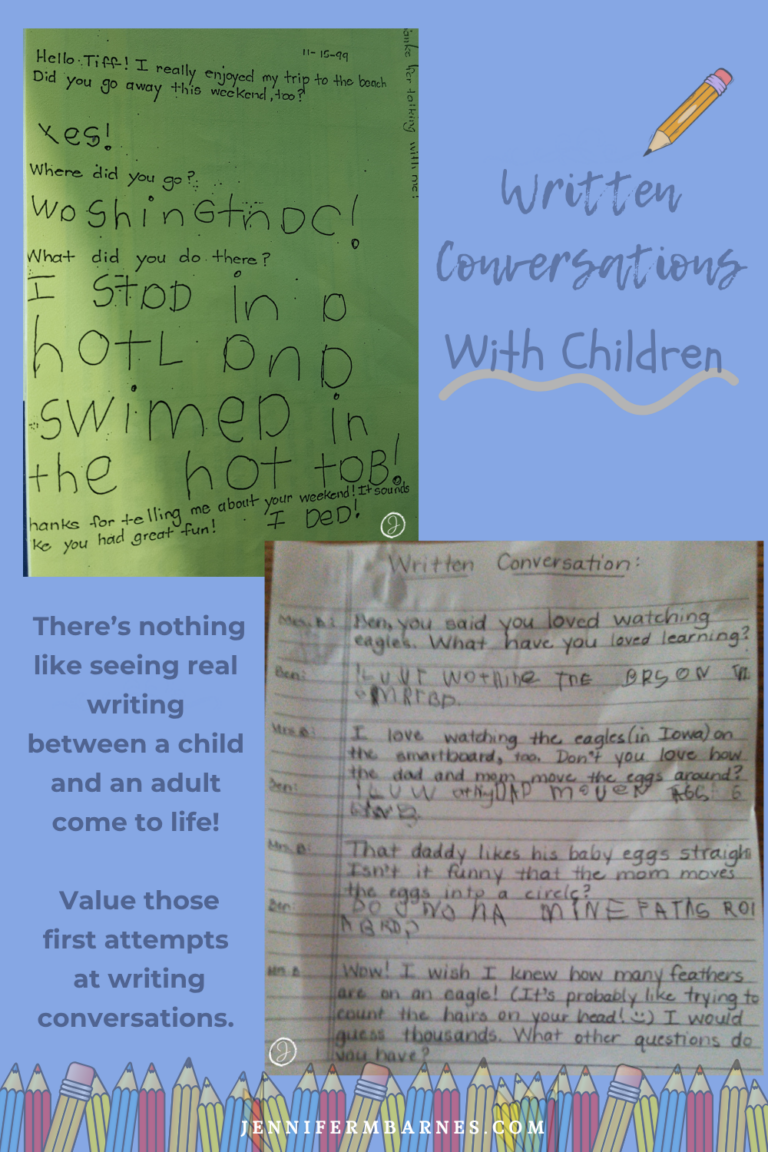
Here are several fun examples of real written conversations. Check out this conversation between my daughter Tiffany and her kindergarten teacher in 1999. Also, see a student’s conversation with me about our observations of an eagle nest in Iowa. (I sure wish they looked better! In those days, we were just trying to teach the process and learn authentically… We rarely thought of how the end product looked – and how we might use them to teach from!)
Note: We invited children to have written conversations with their K/1 friends as well as their fifth-grade buddies and visiting college students.
Let me encourage you to
- Start a journal together to draft your written conversations there. It will be a provocative look back to where your little ones started. And you’ll be amazed to compare where they end up!
- Save conversations from several of your children writing each other at home.
- Capture writings from their teenage and early adulthood years. Just think how fun it will be to browse these heirlooms of your family history in years to come.
The Wisdom of Marie Bradby, the Inspiration for our “Where I’m From” Poems
All these ideas are perfect for grandparents who live close by. But one year in particular, one-third of my students had grandparents living in different countries! I was determined to invite them into our K/1 world, too. The experience began in searching for quality books with stories and illustrations representing a broad range of ethnicities and various pictures of “life long ago.”
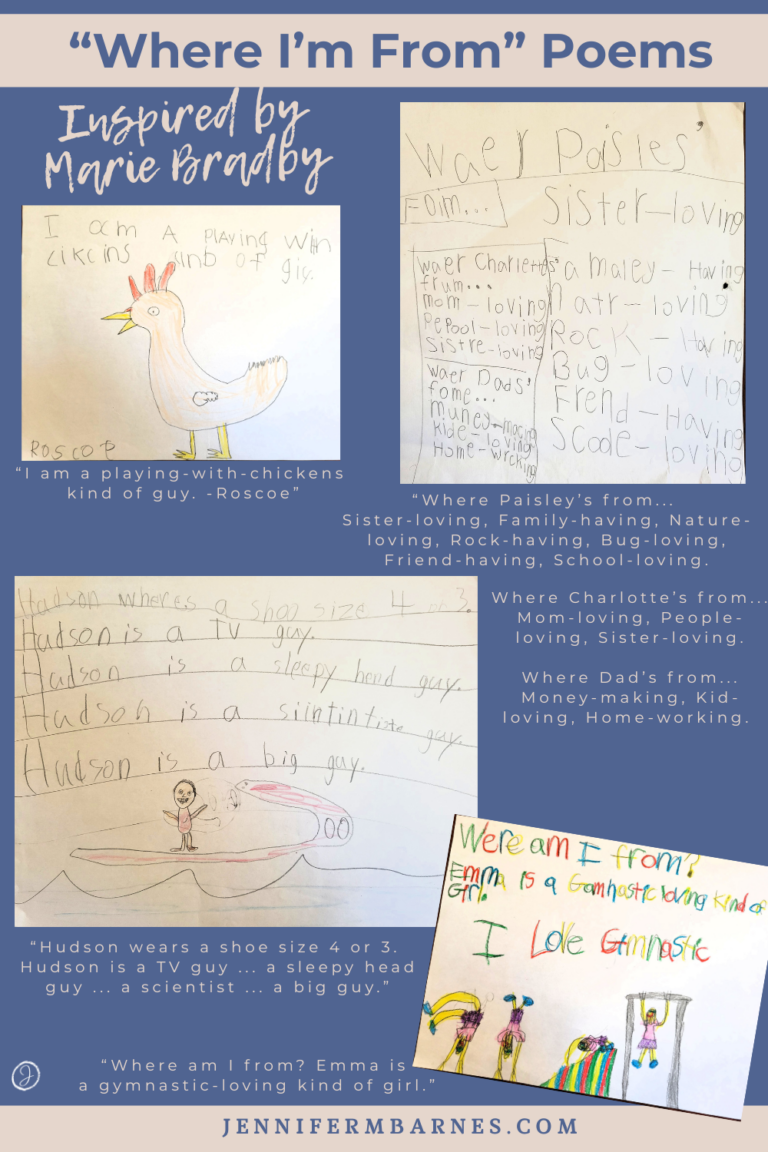
Marie Bradby’s books were a beautiful place to start. One of my favorite picture books, Momma, Where Are You From? inspired us to think about things that represented past and present days of our families. After we read Bradby’s eloquent words and gazed at illuminating illustrations, all my children year after year eagerly set to work to capture themselves and their family. Here are just a few of their first attempts across several different classes:
Illustrator Extraordinaire, Chris Soentpiet
Chris Soentpiet beautifully illustrated Marie Bradby’s book—and many others. As an illustrator, he’s captured some of the most compelling images I’ve ever seen. Our school was blessed when Soentpiet visited for one remarkable day. He so carefully interacted with the children. We weren’t surprised to discover he spends more than a year studying the characters and culture of people he’s drawing to create one children’s book!
A meticulous researcher, Soentpiet ensures he honors everything from the precise fabric, fit, and colors of mid-19th century clothing to attire young Booker T. Washington in More Than Anything Else. In his Peacebound Trains, he ensured his characters were in proper Korean attire. He wrote, “You would never catch one of my Korean characters wearing a Chinese cheongsam, a Japanese kimono, or an Indian sari. While Asian communities may sometimes share similar values or physical features, each culture has its own distinct identity, and I believe it is my job to honor those differences.”
These days with AI: As we’re considering people and history from the past, it’s more important than ever to ensure that the images we show children are accurate and real!
Encourage children to study Soentpiet’s images closely.
- From Marie Bradby’s African-American perspective, Soentpiet draws people sitting on front porches, shelling beans, dancing, drinking Coca-Cola’s, and telling stories around a fire—all showcasing real elements from their lives.
- Or your past might reflect that of Lester Laminack’s Saturdays and Teacakes where a child bicycles through his community (and over the black hose at the gas station), helps his grandma in her garden, swings in her porch glider, and makes teacakes from scratch. (Soentpiet might have studied my grandma’s kitchen to draw the one in that book!)
- Amazing faces shine from the pages of each of his books. You can find people from all over the world beautifully-celebrated in his works. Check his website for more joy, connection, and even bittersweet memories in Soentpiet’s masterpieces.
And Speaking of Masterpieces… Eva Marie Everson’s latest, Miss Beth Bettencourt
There’s just something about reading a book where you remember sharing similar experiences and connecting in powerful ways to the characters and setting. Sometimes they just feel like home.
In Eva Marie Everson’s latest novel for adults, Miss Beth Bettencourt, her vivid writing has brought sweet memories back to life for me. (After all this work you’ve contemplated with children, you deserve to escape into a book of your own!)
The story starts with a shock when Beth heard a stranger snoring in her supposedly-empty house. She found herself in a courtroom the next morning standing up for him. I found myself really caring about her—and him! I sifted through her bittersweet memories and immersed myself in her engaging conversations. Her fast-moving relationship with Marty (the snorer-turned-handyman) and her slowly-changing ones with loyal Polly, constant Harold, and even that deceptive Gordon unfolded into a stunning picture of forgiveness and redemption. It was a tale I won’t soon forget. And I believe you’ll find the story just as striking as I have—whether you grew up in the 1960’s South or not.
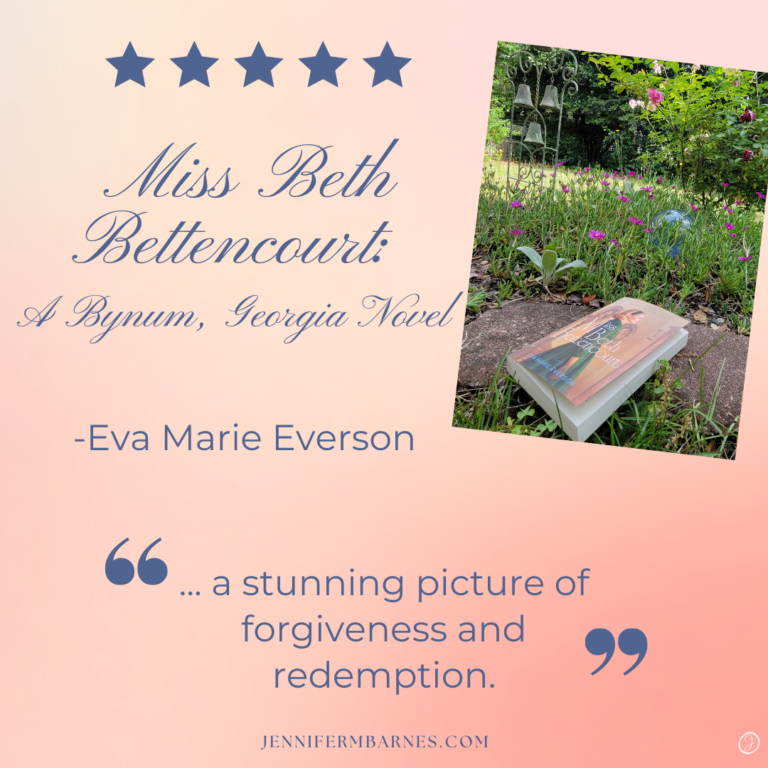
When her characters licked four-cent stamps to mail friendly letters, I recalled the same taste. When Beth flipped pages of the Ladies Home Journal and commiserated about the rising number of students in kindergartens, I realized we would have had lots to talk about. Everson’s imagery of the Sears Catalog, the look of her parents’ repainted bedroom, the smell of Polly’s vegetable soup and cornbread—all of it pulled me into my past. And when the author shared those old-timey commercials and Pinterest images of her characters’ closets, furniture, and cars, all the nostalgia just washed over me. (To see those, scroll below the questions on this podcast to the Listener Giveaway link: “Miss Beth Bettencourt Playlist.” You won’t regret it!)
I guess it is too late for me to enjoy children activities when there are no children around; but the memories are overflowing! Guess I better sit down and start writing about a grandmother’s remembrances!!!! Surely love the author of this blog, as well as her blog!!!
It is NEVER too late! You influence people wherever you go. 😉 But I think your written memories would be priceless, too! People (besides me) would love your memories and your humor. 🩷