
South Carolinians don't really know much about snow and ice
I bet you’ve seen some funny memes with bare bread shelves, water cases being shoved into carts, and empty milk freezers. They’re sort of… true.
We love the idea of experiencing a snow day. When I was teaching though, snow days hardly ever occurred! Honestly, if we happened to have any amount of snow and arrived at school (without a doubt on a two-hour delay), the last little remnants of snow would be gone by lunchtime.
Lunchtime.
If we didn’t play in the snow before lunch together, we’d have to wait YEARS—praying for another perfect day.
That’s why, I always ensured my kids and families knew that if we had the slightest possibility of snow at school, they had to come prepared. We would head outside very first thing in the morning in all their snow gear and play for the first half hour. After all, who could imagine getting to play in snow with ALL your friends at school!?!
Looking back through years of jumbled memories and haphazard photos, I believe I only experienced two, maybe three days of snow play, with little friends at school! (And I taught for more than 30 years. 😊)
What are your students interested in?
My students over the years have been fascinated by a slew of different things from fishing lures and Chipotle to babysitting and Zumba. But, thirteen years ago, this loop of kindergartners and first graders had one thing on their minds. The weather!
Start with conversation
They decided they would be studying snow and ice. (Yep, the math puts them as freshmen in college today.)
We couldn’t imagine living in a place with lots of snow. After all, some of my students had never even seen snow before. But we could certainly read about places like that.
Quality, nonfiction books to inform and delight us
Thankfully, I found this amazing nonfiction picture book, Snowflake Bentley.
Written by Jacqueline Briggs Martin, this book is placed by some professionals on the 4th grade reading level. However, at our morning circle surrounded by little ones dying to know about snow, it was the perfect match. I read a page spread at a time, showed pictures, and highlighted the extra science information in the side bars with totally immersed listeners around me.
We pulled out our huge measuring tape to see exactly how much snowfall Jericho, Vermont had. Mouths agape and little minds blown, we tried to process the information throughout this compelling book.
120 inches of SNOW!?! We looked up to the ceiling, imagining where the 10th foot of snow would land. (Then of course, we talked about how the snow melted and then came again.) But, we remained astounded at the sheer volume of snow!
After each daily reading, we stopped to talk about the harder vocabulary and then condensed the information for ourselves before continuing with the next page spread. Studying snow covered so many content areas (math, reading, geography, science, and art!)
Shared Writing of compelling information
As new-ish writers and scientists, we knew we wanted to capture that information so we wouldn’t forget it. As a class, we came up with several possible sentences to write during our shared writing time. We voted for our favorite.
Then daily, we “shared the pen.” We coached our young writers through each word of our chosen text. (Writers were randomly chosen over several days’ time. All children took a turn as we wrote perhaps 10-12 words a day on a standard-sized 8½” x 11” piece of paper.)
We accepted each child’s approximations. Some children knowingly looked at me when they noticed a friend’s error. But, I winked and we moved on. Our desire was for each child to contribute to our knowledge. And interestingly enough, those more-advanced writers knew what the text said even when they weren’t the ones spelling words out. And equally amazing, my struggling writers developed as stronger writers when their friends served as coaches to their peers.
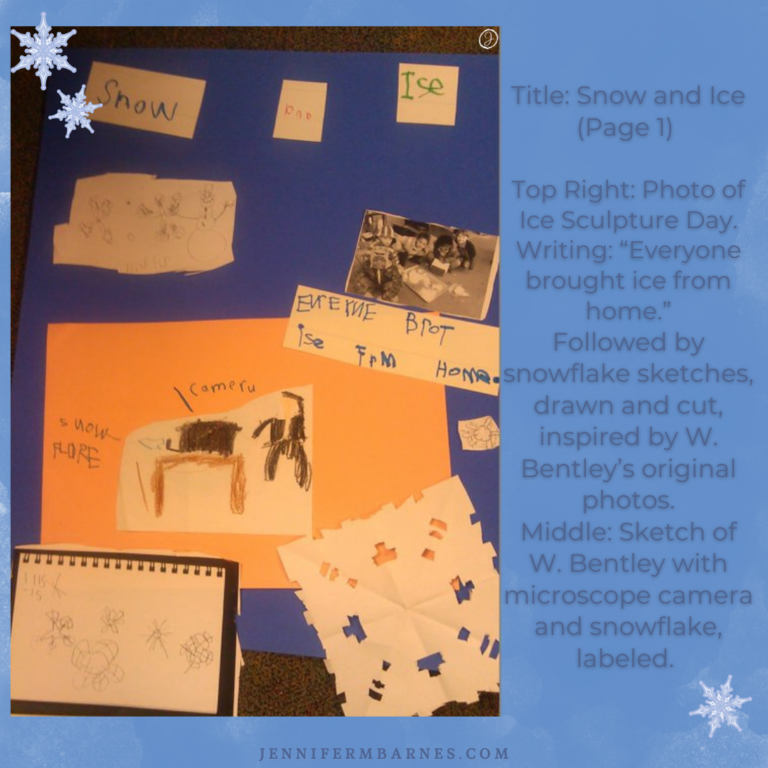
We created a page of interesting snow information together each day. I truly wish I had transcribed all the children’s work and had a beautiful, complete image to share of all our work. What I recognized though is that through these Shared Writing adventures, five-year-olds talked and wrote thoughtfully about:
- the interesting snow scientist and photographer, Wilson Bentley
- the symmetry of snowflakes
- unique parts of old-fashioned cameras and microscope cameras
- life in Vermont
- and the perspectives of photographers.
Pretty sophisticated stuff for kindergartners studying snow!
From Shared Writing to Independent Writing Workshop
After our Shared Writing together, each child excitedly approached their independent writing time by planning and creating books on a variety of topics. Some decided to design their own Snowflake Bentley books. Others wrote on personal snow experiences, their science of snowflakes, or their dreams of a real snow day at school. And throughout the day, I would catch children jotting more important snow pages of their learning across the day. They’d jot notes on whatever style of paper they chose and kept the pieces together at our meeting circle.
Ice Sculpture Day!
Obviously as children learned, they took their new conversations, drawings, and writings home to share with families. Our families became just as excited about snow as the children were. And if we weren’t blessed with a “real” snow day, maybe we could create a special day of our own: Ice Sculpture Day.
One nice thing about involving families is their abundance of innovative ideas. When we asked our families to help create interesting-shaped ice sculptures to bring to school early one morning, they definitely came through. It was one of our most joyous starts ever!
Children squealed as they discovered ice sculptures created from intricate Jello molds, toy containers, cereal bowls, and huge pans. We had each child describe their ice sculpture and invited us to guess how they created them. Then we spent the morning in science explorations—trying to melt them using any means possible, trying to preserve them, seeking to combine them, adding other ingredients to them, and creating other science challenges. Nothing like studying snow and ice by being surrounded by it!
Our Growing Pile of Resources
We literally stacked our work up daily:
- Sketches of Snowflake Bentley’s camera with labels naming the parts.
- Sketches of snowflakes from our sketchpads.
- Intricate snowflakes cut out during our Explorations time.
- Those Shared Writing pieces we had written together.
- Photographs of our students during our Ice Sculpture Day.
- And all those extra pieces of learning the children collected through the days!
Predictably, every time I sat at my teacher’s chair, I’d (accidentally-on-purpose) knock our stack over. Then, I’d sigh loudly and restack.
Until the next time… Sigh and restack.
Finally, a little girl had had enough. She declared, “What should we DO with all our great snow and ice stuff?” We were amazed at how much stuff we had created by simply studying snow.
How to Show Off Your Work To the World
Which led to the children deciding to display it… maybe?
- On what?
- Using what?
Another conversation ensued with lots of great ideas. But, the children were ready to start right then. So, several friends headed to the office to borrow random colors of poster board. We pulled out scotch tape dispensers and simply invited kids to display their materials on our pieces of poster board.
Disclaimer:
Yes, I just let five-year-olds stick tape on things and slap them on posterboard. And yes, some of their parents later looked at it like, “What in the world…?” Some of the children had looked at it like that, too! 😉
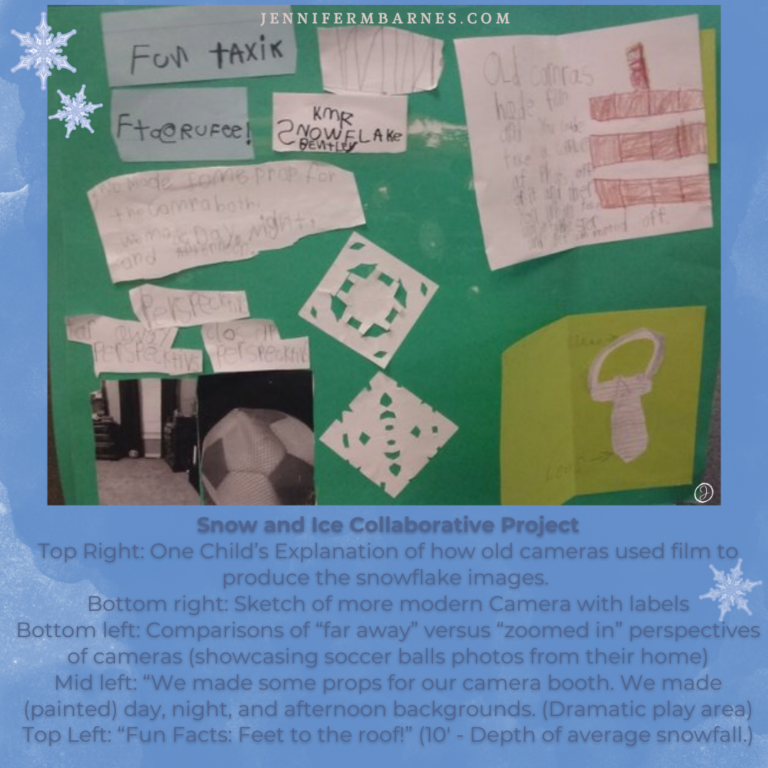
Can little kids REALLY pull together research projects by themselves?
YES! What I wanted to show was that young children were totally capable of:
- using books as a resource for learning
- deciding what to write on their own papers
- using what they know about writing to document their new knowledge
- gathering their own writing
- creating art samples
- collecting photographs
- labeling sketches
- titling a project
- and absolutely being able to communicate their newly-gained information with others.
ALL of them could!
And despite the errors in any piece of the kindergarten project, we felt so proud of our collaborative work.
Setting Them Up Beautifully for Their Individual Expert Projects Later
I also quietly confirmed to children that they totally could do their very own projects one day, making all the decisions themselves about how to “tape right,” whether to line their papers up or display them zigzag, and any other decisions they wanted.
I also never wanted any visitor to say, “Well, how do you know the parents didn’t just do this project?” Really? Take a closer look.
From the beginning, little children were valued as contributing members of their classroom, capable of making decisions about their learning, independently adding content of their own, and talking with their friends about their new shared knowledge.
And That’s How We Spent Time Studying Snow Together… Before Children Figured Out How to Create Expert Projects on Their Own
Such sweet memories of little kids learning how to live with each other’s decisions about projects while learning some amazing information together! And still, every time snow hits in a rare winter in South Carolina, I’m drawn back to that sweet day of children beginning to take responsibility for their learning!
If you have any stellar snow ideas to share, please leave a comment. We’d all love to learn!
I wish every child could have been under your expert teaching! I love reading your ideas and memories from the classroom.
Thank you so much for your kind comment. I adored teaching. All those memories just keep popping up in my life these days! 🎉
You have so much wisdom to share. I hope educators ( and parents!) are making notes! I especially LOVE that you allowed and encouraged students to make their own projects. So many miss out on valuable learning opportunities when parents have to compete with other parents in putting together projects that will ensure their child gets a good grade,
It’s funny. Some adults don’t value those first project attempts as much as you and I do. But, if we want little people to grow up being independent and curious, they’ve got to start somewhere. 😉 They have lots of room to soar from there. I just pray that children are given opportunities to explore and teach others these days. You know I always love your insights, Frances! Thanks for showing up and sharing. 🩷