
Zach's Real-life problem
When our son was in first grade, he fell in love with the Pokémon game on his Gameboy. The problem: This game had tons of text and Zach wanted me to read it to him. Every word.
After reading a bit about Pikachu, Squirtle, and Charizard—and being instructed on how to pronounce each name accurately, I realized this was not going to work out. I reminded him about his reading strategies. Then I said, “Zach, I just can’t. I don’t really love Pokémon and I’m having a hard time just reading their names. If you want to know what they’re saying, I bet you can learn to read this stuff yourself.”
Obviously he was not happy. But that fellow blossomed as a reader… all because he was bound and determined to read the storyline of that little game!
As a teacher of young children for more than 30 years, I saw little ones tackle problems everyday—from reading Gameboys and figuring math problems to hitting a ball and hanging from monkey bars.
Lack of Perseverance in School
Although all my students made the same types of errors in academics and physical skills, I watched this last generation of children react differently. Many would simply sigh and drop their heads, ask someone to tell them the answer instead, or even quit.
- When tackling unknown words, they often said, “I don’t know.”
- When trying to figure out how to spell something, they’d beg, “Just tell me what to write.”
- When working to master a new skill, they’d moan, “I just can’t do it!”
In my weekly newsletters to parents and families, a popular subject became “Strategies to Help Children Persevere.”
Some Simple Ways to Build Perseverance with Little Ones:
“Give it a go.”
My daughter’s brilliant teacher, Dori Gilbert, used a document called “Give It a Go.” She wanted her young readers to think positively as they actively worked to figure unknown words. There were 4-5 blank columns running down the page. If Tiffany didn’t know how to spell something, she wrote what she did know in the first column. When Tiff showed it to her teacher, Dori would enthusiastically jot little check marks over the correct letters and draw lines to show where letters were missing. Tiff would head back to the table to think some more, jotting her new guess in the second column. Subsequently, Dori praised her work—and, if needed, offered hints for her third try. Back and forth, they’d go. By the time Tiffany hit the last column, she figured out the correct spelling.
Can you imagine a better spelling lesson than this? The child has:
- thought deeply
- figured out the easy parts
- gotten encouragement and praise
- received hints
- continued to work
- and finally figured out the word on her own.
What happened the next time Tiffany needed to spell that word? She could easily pull out her “Give It a Go” sheet—or quite often, she simply remembered it from all the quality time spent on the experience.
Part of the “Give it a Go” strategy is the knowledge that you don’t ask someone to do something for you that you haven’t tried for yourself first. And it works for everything:
- Spelling
- Solving word problems
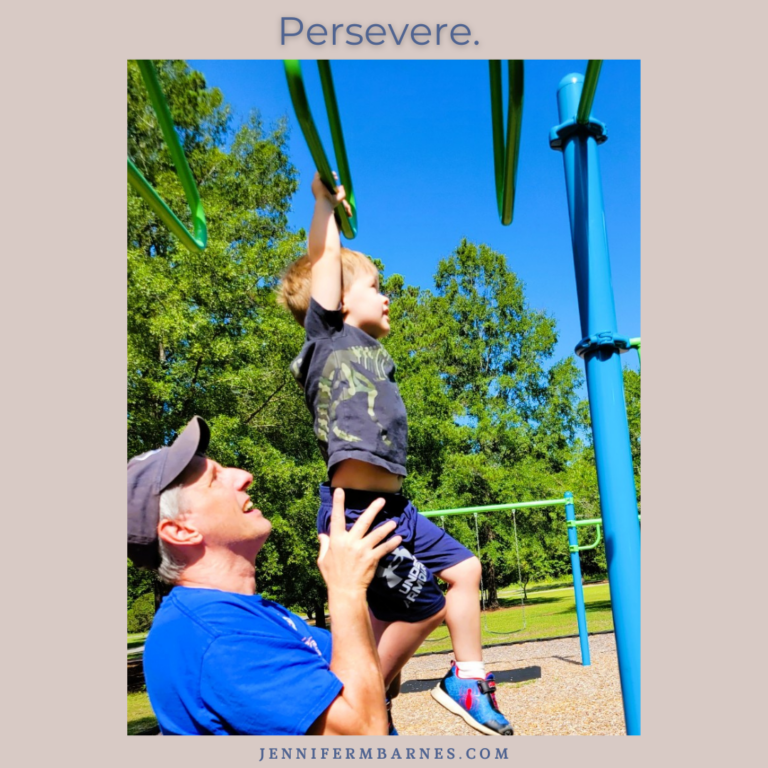
- Trying to hang on lower beams before heading to the high monkey bars.
How incredible that the initial struggle ended up feeling like a game!

Try again… and again… and again…
When trying to ride a bicycle, how often do children pick themselves up and dust themselves off? Again… and again… Don’t we look back and remember this struggle as a part of growing up? Oh, the joy when we discovered we could actually ride those bikes! Perhaps we can empower our own children when we encourage them with stories of things we didn’t know how to do and how we transformed in the end.
Set a timer.
Good things take time. And who doesn’t love a handy tool? Give those kids a timer and teach them how to use it. Begin with five minutes. They might even succeed at the problem before the timer dings. Five or ten minutes is also a manageable amount of time for young children to focus on things that matter. Those initial increments of time will increase as children start challenging themselves to do bigger things.
Approach a problem in different ways.
Kids (and adults) often try the same old strategy every time. Then they become flustered when success doesn’t come. Encourage children to think differently.
- Riding a bike? Watch other kids to see how they stop without falling over.
- Tired of always sounding words out? Read the rest of the words on the page and think about what might make sense and match the letter sounds.
- Trying to paint flowers? Paint alongside them, talk about what moves you’re making. You’ll see them peeking over your shoulder for new ideas.
Sometimes just talking with other people will reveal new things to try that might make a huge difference. When you find people who are challenging themselves at the same types of things, you might want to start a bike-riders team, a book club, or an artists’ guild. You’ll make friends, have fun, and learn how to do something together.
Just keep going.
Don’t give up. All of us get stuck in ruts and become frustrated with hard things. Taking a quick stroll, hanging out in nature, perhaps a snack and a laugh might be all we need to break from our frustrations. Maybe even sleep on the problem! A solution just might pop up. We’ll be excited to return to the work the next day. Whatever your challenge, just keep going.
celebrate the accomplishments.
When the challenge has been met, don’t forget to celebrate. Acknowledge the success and all the time and effort spent in tackling the endeavor. Keep cheering each other on!
A note for parents and grandparents
We can never underestimate the value of children learning how to do things by themselves. As a teacher of 22 children each year, I explained to parents early-on that we would all benefit by encouraging children to accept challenges. (In 1990-1991, I had 30 kids in the morning and 30 in the afternoon.) If I spelled everything for everyone every day, I would never have gotten any teaching done!
A parent's perspective for building perseverance in children
Building children’s confidence and perseverance paid off in more than spelling and math. Using these strategies, our kindergartners learned how to read and research, ask questions, create expert projects, and design whole presentations on their own. Through the years, several parents remarked how refreshing it was to see children’s “real work”, to read their own heartfelt writings (with that cute spelling!), and to see children’s satisfaction in jobs well-done.
Years ago, one mom told me, “My son said he just needed two things from me to pull off his expert project. He wanted to know how to spell platypus the ‘real’ way and he needed a ride to the store to get poster board.” His perseverance paid off with a fantastic project in kindergarten and coming years of curiosity, confidence, initiative, and great accomplishments. (Now, he works as a youth minister in a healthy, growing church.)
An Author and Illustrator Who Perseveres: Nan Carlton
The creator of Huck, Chuck, and Bruce: At the Shore, Nan Carlton discovered this idea during a walk around a pond. She and her husband encountered a few mallards and a Canadian goose. “Look,” he said. “Duck, duck, goose. Sounds like the start of a picture book.” Shortly thereafter, Nan sat and started writing. Her bouncy rhymes and repetition draw children in. They’ll beg you to read the fun story again and again… before they persevere and read it themselves!
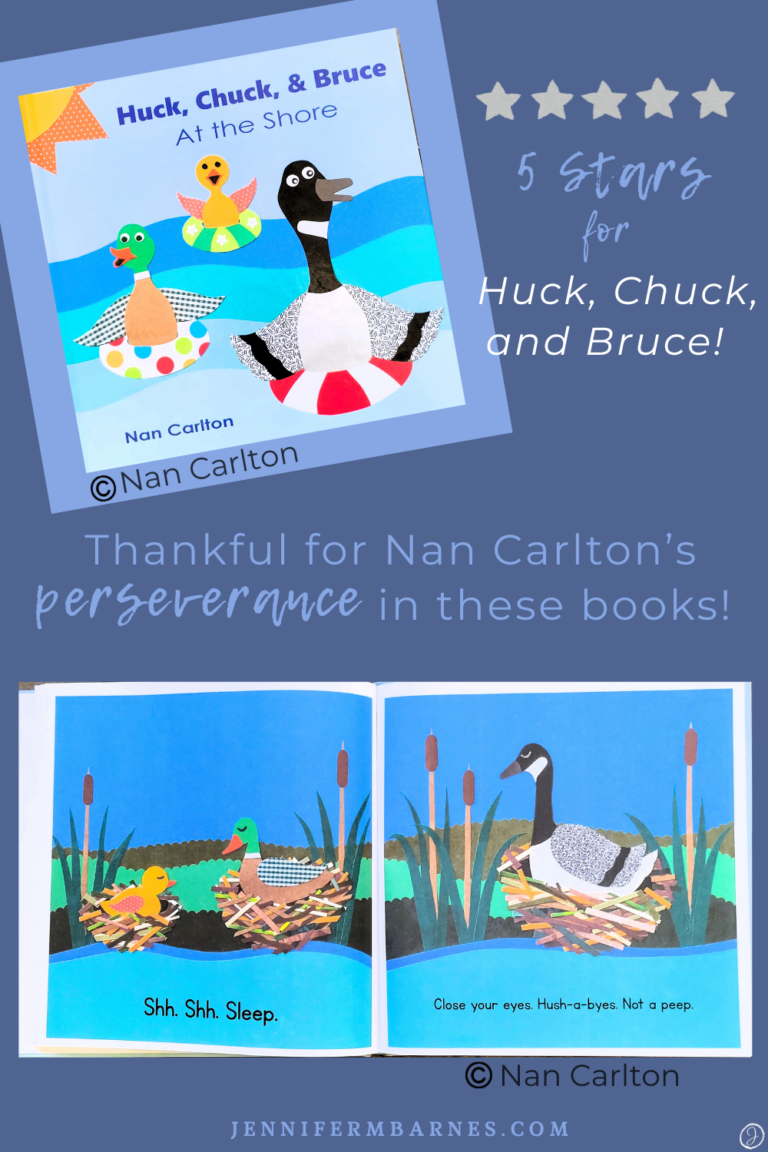
Nan creates her illustrations from ephemera. Ephemera, she declares, is trash, the stuff that normally gets thrown away. Except in Nan’s world. Those restaurant “self-adhesive paper napkin bands” that hold rolled-up silverware in napkins? She uses for flowers. Pretty tissue boxes become backgrounds. And the sympathy card envelopes from her parents’ funerals? They became the lush nests of the ducks and goose on the last page of her precious book.
Nan spends days creating intricate page spreads, cutting around tiny duck legs, and occasionally making a mistake. “When I drop water on a page I’ve spent hours on, I can’t just start over. I have to figure out what to add to the page to cover the stain. It might be a fence post or a patch of flowers… I know mistakes will happen. I’ve just learned that I have to work with what I’ve got.” Perseverance. (Nan’s also written and illustrated You Can’t Judge a Bee by Its Color—and there’s more on the way!)
Author and creator, Eric K. Barnes
Another author and visionary is the creator of Historyman Comics. Six years ago, Eric started a history podcast for adults. Later, he began writing comics so children could learn the true stories of the American Revolution, too. Since that first book, he’s created sixteen: “The Rise of Thomas Sumter,” “The Rise of Francis Marion,” and he’s begun “The Rise of Andrew Pickens.” He’s done a few stand-alone titles in the collection as well.
Eric then set a bigger goal. So, he built an animation team and received a few grants. As of last week, the animation productions of the first six books were released. (Click here to view the animations page on the South Carolina 250th website.)
- 16 comic books
- 6 years
- 3 illustrators
- A team of an animator, a sound studio guy, and 22 voice actors.
All to ensure children know the true history of their country. Perseverance.

How will you persevere in 2026?
Whether you’re tackling a renovation project, coaching a team, writing a book, decluttering a home, or teaching, may you discover dreams for yourself this year. And may you have the perseverance to carry them through.
Many people challenge themselves to become healthier, journal more, plan more family time, or read the Bible in a year. If you’d love to see some great Bible reading plans for 2026, check out the YouVersion Bible App. You can check different translations, pick from a wide variety of plans, and listen to the Bible on the go. (Plus, it’s free!)
If you’d like to know more about the research my kindergartners and I did, check out this post on how my kindergartners have studied their real passions over the years.
Want to know more about “real learning” and what’s going on in our brains? See here.
Such great personal examples of perseverance! Wonderful post, Jennifer!♥️
Aw, thank you so much! There’s nothing like watching little kids grow in confidence as they persevere! 😍 Thanks, as always, for reading!